Innovation and the 3 Horizons Model

I was recently talking to a business owner in the classic conundrum of anyone who has built their own business.  He had a lot of ideas of where to take his business next, with several different innovative offerings laid out before him but no good way to understand what would be exciting growth and what would be an expensive rabbit hole.  He rapidly switched from one wild proposition to another.  Each one was more interesting, and potentially hugely impactful and high risk, than the last.  This is someone I deeply respect and have watched build a remarkable business against a lot of odds.  But as I listened to him, I became increasingly distressed.  It was clear that what had gotten him to the profitable business he now ran was this kind of innovative thought.  But now that he had a successful company with customer promises it needed to keep and a reputation to maintain, this kind of innovative impulsive approach was exactly the thing that was going to cause him great harm.

It was at this point I asked if he was familiar with the three horizons model because it is one of my favorite models for thinking about innovation and growth in a mature business.  He had not and I hope, given you are on this post, it is new to you as well because I love to explain it.  The original model was created by Steve Coley at McKinley and he has done some follow up work on it for a more modern internet economy.  There is also a really nice, but dense, research paper by Shobhit Mittal that looks at 3 Horizons for financial and strategic planning. My goal is not to explain the model in depth.  Please read these linked works if that is what you are looking for.  Instead, I will quickly give you an overview of the theory and pivot to how I have applied the model in multiple situations.

3 Horizon’s Model

To greatly simplify the model, it is a way of thinking about how you divide your attention, and investment, once you have an established product.  It’s looking out over the long term of your business and thinking about opportunities. 
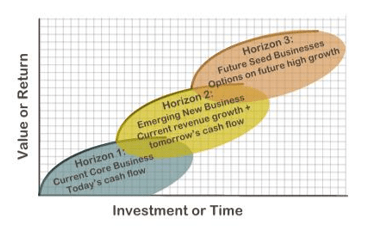
Horizon 1 is your current core business.  Today’s cash flow.  This is the thing that you can rely on day-to-day to make payroll.  If you were in an elevator with someone, it would be the easy answer to what the company you work for does.  For the companies I have worked for this has been things like lead management for Fortune 500 companies, websites for hospitals, logistics services to and within North America.  The core of your identity.  In general, this is where you spend about 65-75% of your company’s time and energy.  It also has risk.  Over time there will be disruption or failure of that line of business.  New competitors (we have talked before about my experience of unexpected competition), new technologies, or a global freight recession.  In general, the goal with H1 is to maintain customer satisfaction while making delivery more efficient.

Horizon 2 is emerging new business.  This is where current revenues can see growth and turn into tomorrow’s case flow.  Most of the time this is to adjacent markets or offerings.  The goal is to get ahead of where the market is going.  Bets that may pay out in 3-5 years.  The relationship between H1 and H2 offering is H2 should be hitting it’s growth phase as 1 is starting it’s decline in order to keep overall business revenue positive.  This is where you spend 15-25% of your efforts.  But it’s really important that these are transitional opportunities.  They have some uncertainty, but they are well grounded in the core business.  Going back to the three example business I mentioned, this would be moving into sales team automation from lead management, selling website marketing to mental health facilities instead of just hospitals, or moving into managed services and consulting from logistics services.  Things you can sell something adjacent into your existing market or something existing to an adjacent market.  It’s where you are still believable for that market and offering.  What I most often see in H2 is going from a pure software offering to services or consulting associated with the problem that software is offering.

Horizon 3 is where your future seed businesses.  These often have high upside but also high risk.  This is where you are thinking about net new offering to an existing market, existing offering to a totally new market, or an adjacent offering to an adjacent market.  This is your more than 5 years out big bets and should be 5-10% of your investment.  Large companies will often purchase horizon 3 opportunities.  You probably don’t have legitimacy yet in the market or the product and there is a lot of speculation.

Segmentation Work Applied to 3 Horizons
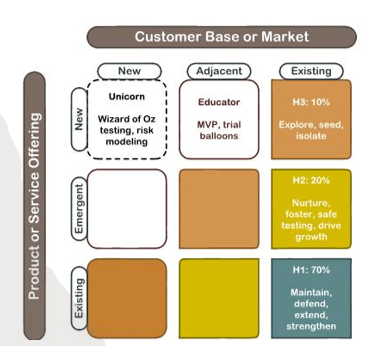
One think I like to do is layer segmentation work, and deep understanding of customer markets, on top of 3 horizons.  My core customer segment lives clearly in Horizon 1.  Here I am working on maintaining, defending, extending, and strengthening.  This is the land of proactive account management, feature enhancements, and support.  H2 becomes more the land of product lead growth and opportunism.  A customer requests something that we never thought of doing but it’s a natural extension.  A partner company asks if you can extend something of what you do to help there.  You find economies of scale.  This is where you nurture, foster, conduct safe testing, and drive growth.  H3, then, becomes the innovator’s delight.  This is wherever startup founder I have ever met wants to play.  It’s exploring and seeding new business ideas.  But it also needs to be isolated to not pollute the core business strength.

“But Jennie”, you ask, “does this mean we never go into those beautiful white squares.  Do I never look at new offerings to a new market?  Or emergent offerings to a new market?”  I know this question because it is the question that my business owner friend asked me over tea.  And the question most successful entrepreneurs have asked me when I explain the model to them.   Because you need that spark of creative genius to found a company.  The thing is, totally innovative offerings are great, but they don’t belong in a company with existing customers and revenue.  They will suck up all the energy in the room educating potential customers, testing out concepts, and doing risk modeling.  Sure, pursue these, but don’t try to do that and run an existing company at the same time.  Because you will start to lose customers by neglecting H1.  This is why a lot of large companies create innovation labs.  I think there is something fundamentally broken about the innovation lab model.  An established company should weave opportunities for H2 and H3 in it’s core processes with reasonable safeguards.  As I told my friend, if you want to explore wider ideas, have someone else run your business first.

How to Vet Horizon 2 and 3 Opportunities

But, you should explore H2 and H3 ideas.  My advice to him was to take each one and write down the answer to each of these questions:

  • What problem am I trying to solve?
  • Why am I the right person to solve that problem?
  • What will be the outcome for my business if I solve that problem?

The answers to those questions, plus an understanding of what horizon you are looking at, should help narrow down where to put your attention for innovation.


Note: I don’t use AI to help write my posts or create example pictures.  Sometimes I use AI to do featured images but in this post all work is mine and was originally presented in conference talk.
ICP Explainer pt 2: Build Their Dreams

One of my favorite product tools, especially when talking to non-product folks, is the Ideal Customer Profile.  That is because it finds that perfect overlap between the deep history of targeted marketing and easy to understand explain metaphors.  Too often when I am talking to business leaders, senior engineers, or customer support staff the theory is too much.  They want a quick mental model they can align their thinking with.  ICP is exactly that.  Also, I get to make fun jokes about Insane Clown Posse.

Fundamentally, an ICP is answering the questions “who are we building this for” and “what problem are we solving for them”.  Which means it is super powerful for when we are having tradeoff or prioritization conversations.  With many of the startup founders I have worked with we have used an ICP to focus limited energy in both product and sales.  With larger companies, I have used to clearly understand who we are saying ‘no’ to and why as well as force conversations about purpose drift.  Super useful.

But also, super dry.

I can give you examples of what an ICP is and then a step-by-step process on how to build them.  I can give you a bunch of anti-patterns and failures with the related cautions.  I can give you all the “it depends” across industries and business models.  And you will get that down there if you want to scroll.  But that’s boring at it doesn’t help with the goal I actually have with most product tools: mental models that help us communicate.

We are writing a novel.  A story of a person with a great need.  One day our main character wakes suddenly up in the middle of the night, sheet damp with sweat and a great anxiety gripping their chest.  They were dreaming of something that would solve their biggest problem, and it was right there, within their grasp.  But as the dream slides away, they are left with a pressing certainty that they will never find the solution.

What is the problem they are having?  What relief will they feel when they solve it?  What are the characteristics of them, as a character, that makes that problem so prominent it is waking them in the middle of the night?  Who are they?  That person is your ideal customer.  They are deeply motivated.  They have a real tangible problem.  And solving that problem will create deep meaningful relief.  The ICP isn’t a mishmash of your existing customer’s characteristics.  It’s not a set of demographics that describes a huge swath of the population (which is somehow always a woman 35-45 with 2 children named Jennifer).  And it can be expressed crisply with clear things it isn’t.

B2B and B2C examples

So, let’s walk through a couple examples and then we can talk about how we build it.

  • Online consumers looking for rare or hard-to-find books (Amazon of the early aughts)
  • Families looking for interactive and collaborative games (Wii)
  • Sales leaders with complex and consultative sales processes looking to organize their sales team’s time and focus (salesforce.com in the early aughts)
  • Hospital and Health System marketers looking for HIPPA-compliant and expert website development and online marketing (CMS company I worked with)
  • Developer-tool companies looking to connect meaningfully with the developer community (social media startup I worked with)

With one of these clear descriptions of who we are serving and what problems we are solving for them I can test out what we should and shouldn’t be doing.  Let’s focus on the complex and consultative sales process tool.  I’m building a product that serves the sales leaders.  I have gotten a request to create marketing attribution fields (where the lead came from).  Do I build it?  Does it help the sales team sell?  Sometimes knowing where the lead came from can help open a conversation.  So I don’t need that information for marketing attribution, I need it to help the sales team start a conversation.  Does it help the sales leadership team?  Yes, knowing which channels are resulting in better sales helps me structure my team’s focus.  So the reason I am building this feature has changed.  I have clarified why I am building a feature (marketing attribution) to the needs of my primary users.

Anti-Patterns

To better understand how to use this tool, it’s important to start with what it is not.  It is not a buyer persona.  This is not the tool you use to fill your sales pipeline or prospect.  Buyer personas are super useful and often contain some of the same demographic and psychographic elements.  However, buyer personas are about who you are targeting with marketing and sales messages.  They will be a lot broader than an ICP because while you can target firmographics (the characters of a company) and demographics it’s a lot harder to target pain points.  Buyer personas are about authority, timeline, budget, and need.  They are a point in time about that sales process.  ICPs are an idealized set of characteristics about the perfect customer, one you will almost certainly never meet.  They are needs forward not personal characteristics forward.

It’s not who we want to be when we grow up.  It’s who we want to be right now.  If you are currently looking at horizon 2 or 3 explorations, you want to develop an ICP specifically for those experiments and test against it to see how you are getting penetration.  Often startups will start with an ICP and test to see if they get traction within that persona.  If they don’t then they tweak the ICP.  Companies with an existing customer base should have an ICP for their core business and then experimental ICPs for potential innovation that are adjacent to the core business.  I sell into hospitals and I want to experiment with selling into other highly regulated businesses, that is a new ICP and I need to better understand the demographics and pains of that new customer set.  Large companies may have multiple ICPs for their core business, like the Fortune 500 company I worked with.  The mistake is muddying them together into one ICP.  That quickly becomes an “everything for everyone” model.  Your ICP must have someone you are saying “no” to.  Sub divide to where you have product/market fit (PMF) even when, often, it is the same product across multiple PMF models.

It is not a current customer profile like account management will use.  Nor will it be user journeys that UXR and product will develop.  This isn’t how the current users interact with the current offerings.  It’s about what the ideal customer needs because of the deep need we are solving for them.

Similarily, in B2B, you must be conscious that your buyer isn’t always your user.  So much like the sales leadership vs sales team example above, the ICP is incorporating all those people together.  The problem you are solving is the intersection of the needs of the buyer and the needs of the user.  You can’t focus all on one or other.

Building an ICP

We are going to go about this in this pattern Pain Points -> Attributes -> Demographics Profile

To build an ICP start by answer the question “What problem are we trying to solve”?  It may be easier to reverse this question and ask “Thinking about my most ideal customer, what problem do they have that they currently find unsolvable”?  Write it all down.  Then go through each problem and statement and ask “do I want to solve this problem?” until you have a set of problem statements (customer pains) that you want to solve.

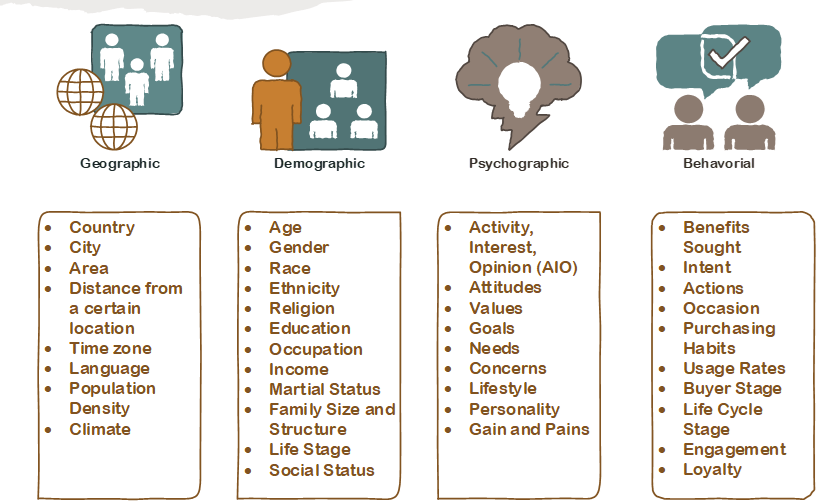
Now having a problem statement, you can start to think about characteristics of a customer with that problem.  If you have existing customers, this can be looking at commonalities of those customers that are related to the problem statement.  Here is my handy cheat sheet of characteristics to segment based on:

Now you have a profile.  Test it.  Look at each attribute and say “is this really compelling?” and “does this change customer motivation?”.  Must like all marketing profiles become, well, me.  It’s easy to just reduce yourself to the most common demographic properties of your population.  The name Jennifer was really popular in the 80s, women 35-45 have a lot of buying power, and that demographic is really likely to be married with 2 kids.  None of those characteristics are likely to be compelling to any particular problem statement.  I don’t need software to organize my kid’s schedules because I am in my 40s and married.  Having kids is compelling.  But likely being a busy professional and upper income are more impactful on that need.

Application

Once I have a ICP that I have walked around the organization it become a foundation for conversations we have with stakeholders and inside the team.  Does this feature help our ICP?  What are we saying no to?  Do our recent customers look like our ICP?  If there is slide, what is it and does it mean we need to adjust the ICP or we are starting to muddy our value proposition?  How recently have we talked to a customer who looks like our ICP?  What needs did they have that we aren’t currently solving?

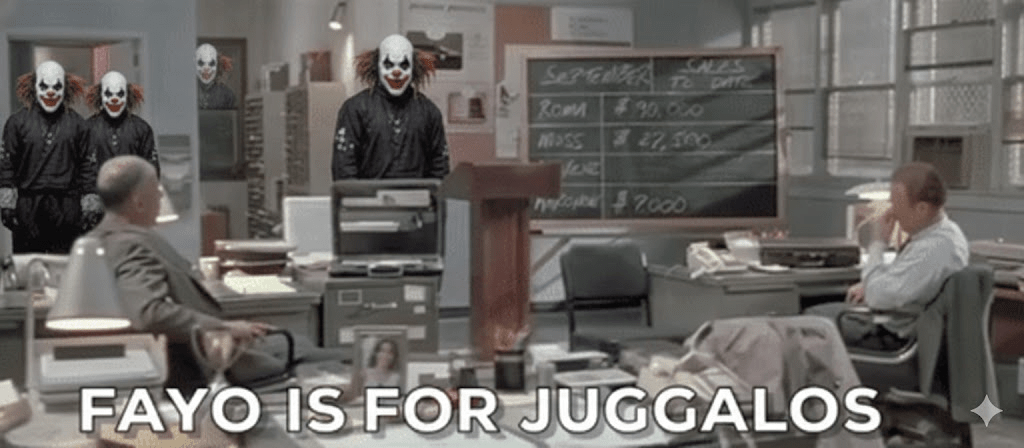
Note: I don’t use AI to help write my posts or create example pictures. The segmentation cheat sheet is my creation and is also present in my Build Things People Want talk.  I did use AI  to create the header image, in this case ChatGPT with the prompt “create an image of glenngarry glen ross in the style of insane clown posse”.

ICP explainer: Segment the World!

One day, a few years ago, I was chatting with an enterprise architect about some of the prioritization and focus issues the team was facing.  I told him “our real problem is that we don’t know our ICP”.  To which he paused for a long beat and said “Insane Clown Posse?”.

Fair enough.  I grew into product building at an early B2B CRM company before the rise of salesforce.com steeped in Glenngarry Glen Ross, Alan Cooper’s personas, and Angus Jenkinson’s customer segmentation strategy.  I have a coffee mug that boldly proclaims, “Ritalin is for closers”.  He grew up bleeding his ears with death metal while generating beautiful code.  Fair enough. An Ideal Customer Profile (ICP) sits at the intersection of emerging marketing trends and deep thinking about product intention for who we are selling to. Let’s break it down.

A Brief History of Targeted Marketing

Back in the late 90s and early 00s we were going through a major transition in how we thought about marketing and sales, driven by the move from mass marketing to personalized marketing enabled by the internet.  There was a deep divide between large companies, who were trying to serve everyone, and small companies, who were embedded in the needs of their community. Now instead of just blasting a message “drink my sugary beverage” with compelling images and social pressure, you could target certain demographics with marketing, and products, specifically suited to their needs.  By the early aughts, the internet made it possible for small producers to find their niche markets and customers to be more exacting in their needs.  Webpages popped up to serve these needs.  Instead of having the choice between two sugary carbonated beverages, consumers could demand, and find, a wide assortment of specialty products: probiotic, low sugar, fruit juice based.  The world exploded with options, and the search engines came to help organize (and monetize) it.  By the end of the aughts we have social media, YouTube, and targeted marketing.  And a lot of noise.

The same thing happened in B2B sales, which I got to watch firsthand from my first product job at a lead management and customer relationship company working with large multi-nationals.  It was no longer enough to manage your supply chain, distribution network, and brand reputation.  Now you needed to think with more precision about who you were selling to.  Enter concepts that are still with us today: personas, buyer journey, segmentation, and ideal customer profile.  To be clear, these concepts were always there, unnamed in the dusty corners of pitch rooms.  Companies always have differentiated products into different markets, see also: the different sizes of candy bars or packaging of soap at different retail locations.  But what happened was an acceleration of need for this deep thinking and an explosion of competition.  Not only could big companies have more ways to segment customers, but smaller companies could quickly identify and build into gaps.  Pets.com didn’t survive but targeted marketing sure did.  Just remember that congressional testimony about the Facebook business model from Zuckerberg: “Senator, we run ads”.  User data, micro-targeting, segmentation is a standard operating process now.  You must be a lot more intelligent about your “who” to survive.  Stop smirking Mark.

Enter the Blue Ocean Strategy

Another important aspect of this trend is the impact of the Blue Ocean Strategy and long-tail marketing.  In 2004, Renée Mauborgne and W. Chan Kim publish a book that basically says that instead of competing in the same market everyone else is, the red ocean, find the place where there is an underserved customer base.  I say that out loud and it sounds obvious, but it was anything but in practice.  Remember we are at an age when scale is a major factor in success.  Big companies survive through inertia and small companies can only get so big before they are eaten.  The SMB market is overwhelmingly either hyper local or suppliers to the big boys (like the company I worked for).  A concept we saw deeply tested by the 2001 Enron scandal and shattered in the 2008 lehman brother collapse during the financial crisis.  Big companies fail too sometimes.

When you look at market opportunities, if you look where other companies already are you must spend your time making a value-cost trade off and differentiate on either quality or cost.  This “red ocean thinking” drives the middle out of a market and results in either high cost “specialized” or brand goods or a race to low-cost efficiency.  Luxury handbags are an example of the former, Walmart is an example of the latter.  The classic example of blue ocean strategy for me is the Wii.  When the Wii arrived on the video game market in 2006 it was revolutionary.  With it’s shorter play times and more party game style, it was going after a totally different interaction pattern and market.  It really was a precursor to the phone games that now take up way too much of my screen time.  Standalone gaming systems was already a deeply competitive and saturated market with Playstation and Nintendo sucking up all the air, and occasionally Xbox producing something reasonable (gotta give love to Grand Theft Auto).  By 2006 it was a market that had falling into an arm’s race based purely on computer specs.  But the Wii wasn’t for teenage boys (and girls thank you very much) in their parent’s basements (and dorm rooms).  It was suddenly targeting their parents with memorable, collaborative experiences.  With games that were about getting up and moving, and interacting with people in the same room, it was a totally different concept.  It could include the entire family.  But there were two absolutely genius things the inventors of the Wii understood that it took years for the rest of the market to catch on to:

  1. Parents are the ones with the money, not the kids
  2. Kids becomes adults

Because, fundamentally, they changed the value proposition for a gaming console into a market that really had no competition.  Atari started the market, really, in 1977.  The Nintendo first hit the states in 1985 with Playstation following in 1994 and Xbox in 2001.  By 2006 the Blue Ocean that Atari and Nintendo had discovered had become bloody.  But also, the children (cough me and my brother cough) who begged their parents for those early gaming systems (I still miss my duck hunt) had grown into adults.  Gaming had become mainstream, and with it, what some (read: me but not my brother) wanted from it was evolving.  There was still a market for gaming systems targeting people who wanted to spend hours immersed in a story (teenagers) but there was now an acceptable market for adults who want to casually game.  I will also point out that Wii may have been the first gaming system to understand that half the population is female and we don’t just don’t want “pink it and shrink it”.  That’s the wrong way to do segmentation.  The Wii did it right. Again, same thing happens with B2B it’s just the consumer goods examples are so much easier. 

Wag the Long Tail Marketing

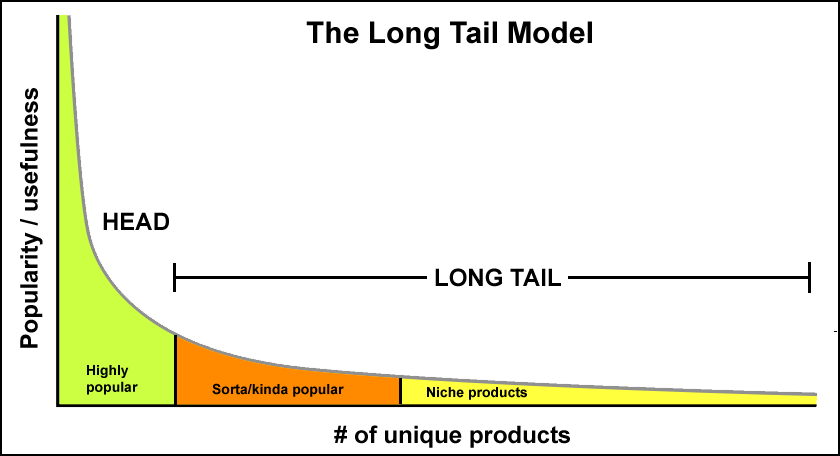
In October 2004, Chris Anderson publishes an article in Wired magazine called “The Long Tail” which he later turned into a book in 2006.  The concept here, again, feels obvious in retrospect but was revolutionary at the time.  If you think about market demand on a chart there is a lot of demand for a few products and then there are a bunch of products with a really niche market demand.  Most companies obey Sutton’s law and go after products where there is the most market demand.  “Why do you rob banks?” “Because that’s where the money is.”  But that means there is a lot of need in those niche markets that are harder to solve.  Enter the internet and catalog management most famously visible with early Amazon.  When they were just a book seller they differentiated themselves by providing a very expansive catalog.  While you could go to any bookstore to find the newest best seller, if you were looking for a niche book you just couldn’t find it without going to a specialized seller.  Enter the internet and not only could those niche book producer start to find their market easier but a company like Amazon could include those niche books in their catalogue without risk.  You don’t have to stock it if no one buys it. 

By 2004 the economic reality Anderson could point to is that sales into those niche markets could outperform the bestsellers with lower competition (blue ocean), higher conversion rates, and better brand loyalty.  There are a lot of other reasons why early Amazon was successful which is probably a different blog post but I’ll drop another here for context: they understood they weren’t selling books.  They were selling trusted access to niche markets.  In the early aughts Amazon was a safe place to give your credit card number to get those specialized items.  Way safer than going to “momandpopbooks.org”.

Long tail marketing is born because of digitalization and better market access.  Sits on top of blue ocean strategy, social media, and segmentation strategy.  It then helps give birth to the influencer which I am, of course, too old to understand.  But all of these factors, together, break the old ways of marketing.  Companies can no longer sell “everything to everybody” and perhaps they never could.  The last decades have seen the end of “everything stores”, also known as department stores, like Sears.  It’s not just the move online but also the ability to easily create niche products, find segmented customers, and compete in markets that were incredibly inefficient to target before, and therefore were left to companies without scale.  So we come to today with all these factors changing the how we go to market and who we target.  Enter Insane Clown Posse… I mean, cough, Ideal Customer Profiles.

Tune in Next time, same Bat-Post, same Bat-Blog

This was going to be one post talking about ICP, modern considerations, how to build it and apply it, and cautions and anti-patterns.  But I was having too much fun with the history, and I think the context is too often glossed over.  So, we will continue with application next time.  And maybe I’ll even try to drop some sick rhymes.

Note: I don’t use AI to help write my posts.  I did use search, and the associated embedded AI that is everywhere, to find the actual dates, links, and references I made throughout this post because I wanted to provide credit where it is due.  I also used Google Gemini to create the header image because I couldn’t resist Glenn2dope Glen Violent J.