I was recently talking to a business owner in the classic conundrum of anyone who has built their own business. He had a lot of ideas of where to take his business next, with several different innovative offerings laid out before him but no good way to understand what would be exciting growth and what would be an expensive rabbit hole. He rapidly switched from one wild proposition to another. Each one was more interesting, and potentially hugely impactful and high risk, than the last. This is someone I deeply respect and have watched build a remarkable business against a lot of odds. But as I listened to him, I became increasingly distressed. It was clear that what had gotten him to the profitable business he now ran was this kind of innovative thought. But now that he had a successful company with customer promises it needed to keep and a reputation to maintain, this kind of innovative impulsive approach was exactly the thing that was going to cause him great harm.
It was at this point I asked if he was familiar with the three horizons model because it is one of my favorite models for thinking about innovation and growth in a mature business. He had not and I hope, given you are on this post, it is new to you as well because I love to explain it. The original model was created by Steve Coley at McKinley and he has done some follow up work on it for a more modern internet economy. There is also a really nice, but dense, research paper by Shobhit Mittal that looks at 3 Horizons for financial and strategic planning. My goal is not to explain the model in depth. Please read these linked works if that is what you are looking for. Instead, I will quickly give you an overview of the theory and pivot to how I have applied the model in multiple situations.
3 Horizon’s Model
To greatly simplify the model, it is a way of thinking about how you divide your attention, and investment, once you have an established product. It’s looking out over the long term of your business and thinking about opportunities.
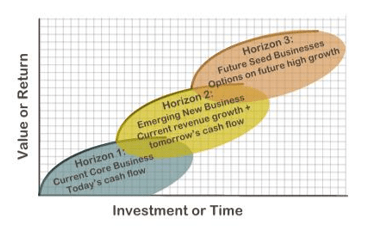
Horizon 1 is your current core business. Today’s cash flow. This is the thing that you can rely on day-to-day to make payroll. If you were in an elevator with someone, it would be the easy answer to what the company you work for does. For the companies I have worked for this has been things like lead management for Fortune 500 companies, websites for hospitals, logistics services to and within North America. The core of your identity. In general, this is where you spend about 65-75% of your company’s time and energy. It also has risk. Over time there will be disruption or failure of that line of business. New competitors (we have talked before about my experience of unexpected competition), new technologies, or a global freight recession. In general, the goal with H1 is to maintain customer satisfaction while making delivery more efficient.
Horizon 2 is emerging new business. This is where current revenues can see growth and turn into tomorrow’s case flow. Most of the time this is to adjacent markets or offerings. The goal is to get ahead of where the market is going. Bets that may pay out in 3-5 years. The relationship between H1 and H2 offering is H2 should be hitting it’s growth phase as 1 is starting it’s decline in order to keep overall business revenue positive. This is where you spend 15-25% of your efforts. But it’s really important that these are transitional opportunities. They have some uncertainty, but they are well grounded in the core business. Going back to the three example business I mentioned, this would be moving into sales team automation from lead management, selling website marketing to mental health facilities instead of just hospitals, or moving into managed services and consulting from logistics services. Things you can sell something adjacent into your existing market or something existing to an adjacent market. It’s where you are still believable for that market and offering. What I most often see in H2 is going from a pure software offering to services or consulting associated with the problem that software is offering.
Horizon 3 is where your future seed businesses. These often have high upside but also high risk. This is where you are thinking about net new offering to an existing market, existing offering to a totally new market, or an adjacent offering to an adjacent market. This is your more than 5 years out big bets and should be 5-10% of your investment. Large companies will often purchase horizon 3 opportunities. You probably don’t have legitimacy yet in the market or the product and there is a lot of speculation.
Segmentation Work Applied to 3 Horizons
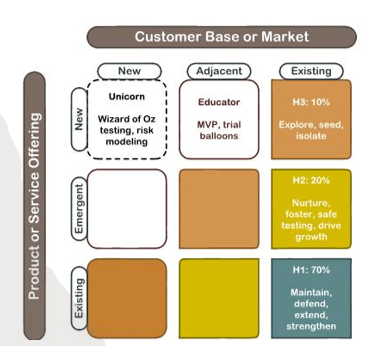
One think I like to do is layer segmentation work, and deep understanding of customer markets, on top of 3 horizons. My core customer segment lives clearly in Horizon 1. Here I am working on maintaining, defending, extending, and strengthening. This is the land of proactive account management, feature enhancements, and support. H2 becomes more the land of product lead growth and opportunism. A customer requests something that we never thought of doing but it’s a natural extension. A partner company asks if you can extend something of what you do to help there. You find economies of scale. This is where you nurture, foster, conduct safe testing, and drive growth. H3, then, becomes the innovator’s delight. This is wherever startup founder I have ever met wants to play. It’s exploring and seeding new business ideas. But it also needs to be isolated to not pollute the core business strength.
“But Jennie”, you ask, “does this mean we never go into those beautiful white squares. Do I never look at new offerings to a new market? Or emergent offerings to a new market?” I know this question because it is the question that my business owner friend asked me over tea. And the question most successful entrepreneurs have asked me when I explain the model to them. Because you need that spark of creative genius to found a company. The thing is, totally innovative offerings are great, but they don’t belong in a company with existing customers and revenue. They will suck up all the energy in the room educating potential customers, testing out concepts, and doing risk modeling. Sure, pursue these, but don’t try to do that and run an existing company at the same time. Because you will start to lose customers by neglecting H1. This is why a lot of large companies create innovation labs. I think there is something fundamentally broken about the innovation lab model. An established company should weave opportunities for H2 and H3 in it’s core processes with reasonable safeguards. As I told my friend, if you want to explore wider ideas, have someone else run your business first.
How to Vet Horizon 2 and 3 Opportunities
But, you should explore H2 and H3 ideas. My advice to him was to take each one and write down the answer to each of these questions:
- What problem am I trying to solve?
- Why am I the right person to solve that problem?
- What will be the outcome for my business if I solve that problem?
The answers to those questions, plus an understanding of what horizon you are looking at, should help narrow down where to put your attention for innovation.
Note: I don’t use AI to help write my posts or create example pictures. Sometimes I use AI to do featured images but in this post all work is mine and was originally presented in conference talk.

