One of my favorite product tools, especially when talking to non-product folks, is the Ideal Customer Profile. That is because it finds that perfect overlap between the deep history of targeted marketing and easy to understand explain metaphors. Too often when I am talking to business leaders, senior engineers, or customer support staff the theory is too much. They want a quick mental model they can align their thinking with. ICP is exactly that. Also, I get to make fun jokes about Insane Clown Posse.
Fundamentally, an ICP is answering the questions “who are we building this for” and “what problem are we solving for them”. Which means it is super powerful for when we are having tradeoff or prioritization conversations. With many of the startup founders I have worked with we have used an ICP to focus limited energy in both product and sales. With larger companies, I have used to clearly understand who we are saying ‘no’ to and why as well as force conversations about purpose drift. Super useful.
But also, super dry.
I can give you examples of what an ICP is and then a step-by-step process on how to build them. I can give you a bunch of anti-patterns and failures with the related cautions. I can give you all the “it depends” across industries and business models. And you will get that down there if you want to scroll. But that’s boring at it doesn’t help with the goal I actually have with most product tools: mental models that help us communicate.
We are writing a novel. A story of a person with a great need. One day our main character wakes suddenly up in the middle of the night, sheet damp with sweat and a great anxiety gripping their chest. They were dreaming of something that would solve their biggest problem, and it was right there, within their grasp. But as the dream slides away, they are left with a pressing certainty that they will never find the solution.
What is the problem they are having? What relief will they feel when they solve it? What are the characteristics of them, as a character, that makes that problem so prominent it is waking them in the middle of the night? Who are they? That person is your ideal customer. They are deeply motivated. They have a real tangible problem. And solving that problem will create deep meaningful relief. The ICP isn’t a mishmash of your existing customer’s characteristics. It’s not a set of demographics that describes a huge swath of the population (which is somehow always a woman 35-45 with 2 children named Jennifer). And it can be expressed crisply with clear things it isn’t.
B2B and B2C examples
So, let’s walk through a couple examples and then we can talk about how we build it.
- Online consumers looking for rare or hard-to-find books (Amazon of the early aughts)
- Families looking for interactive and collaborative games (Wii)
- Sales leaders with complex and consultative sales processes looking to organize their sales team’s time and focus (salesforce.com in the early aughts)
- Hospital and Health System marketers looking for HIPPA-compliant and expert website development and online marketing (CMS company I worked with)
- Developer-tool companies looking to connect meaningfully with the developer community (social media startup I worked with)
With one of these clear descriptions of who we are serving and what problems we are solving for them I can test out what we should and shouldn’t be doing. Let’s focus on the complex and consultative sales process tool. I’m building a product that serves the sales leaders. I have gotten a request to create marketing attribution fields (where the lead came from). Do I build it? Does it help the sales team sell? Sometimes knowing where the lead came from can help open a conversation. So I don’t need that information for marketing attribution, I need it to help the sales team start a conversation. Does it help the sales leadership team? Yes, knowing which channels are resulting in better sales helps me structure my team’s focus. So the reason I am building this feature has changed. I have clarified why I am building a feature (marketing attribution) to the needs of my primary users.
Anti-Patterns
To better understand how to use this tool, it’s important to start with what it is not. It is not a buyer persona. This is not the tool you use to fill your sales pipeline or prospect. Buyer personas are super useful and often contain some of the same demographic and psychographic elements. However, buyer personas are about who you are targeting with marketing and sales messages. They will be a lot broader than an ICP because while you can target firmographics (the characters of a company) and demographics it’s a lot harder to target pain points. Buyer personas are about authority, timeline, budget, and need. They are a point in time about that sales process. ICPs are an idealized set of characteristics about the perfect customer, one you will almost certainly never meet. They are needs forward not personal characteristics forward.
It’s not who we want to be when we grow up. It’s who we want to be right now. If you are currently looking at horizon 2 or 3 explorations, you want to develop an ICP specifically for those experiments and test against it to see how you are getting penetration. Often startups will start with an ICP and test to see if they get traction within that persona. If they don’t then they tweak the ICP. Companies with an existing customer base should have an ICP for their core business and then experimental ICPs for potential innovation that are adjacent to the core business. I sell into hospitals and I want to experiment with selling into other highly regulated businesses, that is a new ICP and I need to better understand the demographics and pains of that new customer set. Large companies may have multiple ICPs for their core business, like the Fortune 500 company I worked with. The mistake is muddying them together into one ICP. That quickly becomes an “everything for everyone” model. Your ICP must have someone you are saying “no” to. Sub divide to where you have product/market fit (PMF) even when, often, it is the same product across multiple PMF models.
It is not a current customer profile like account management will use. Nor will it be user journeys that UXR and product will develop. This isn’t how the current users interact with the current offerings. It’s about what the ideal customer needs because of the deep need we are solving for them.
Similarily, in B2B, you must be conscious that your buyer isn’t always your user. So much like the sales leadership vs sales team example above, the ICP is incorporating all those people together. The problem you are solving is the intersection of the needs of the buyer and the needs of the user. You can’t focus all on one or other.
Building an ICP
We are going to go about this in this pattern Pain Points -> Attributes -> Demographics Profile
To build an ICP start by answer the question “What problem are we trying to solve”? It may be easier to reverse this question and ask “Thinking about my most ideal customer, what problem do they have that they currently find unsolvable”? Write it all down. Then go through each problem and statement and ask “do I want to solve this problem?” until you have a set of problem statements (customer pains) that you want to solve.
Now having a problem statement, you can start to think about characteristics of a customer with that problem. If you have existing customers, this can be looking at commonalities of those customers that are related to the problem statement. Here is my handy cheat sheet of characteristics to segment based on:
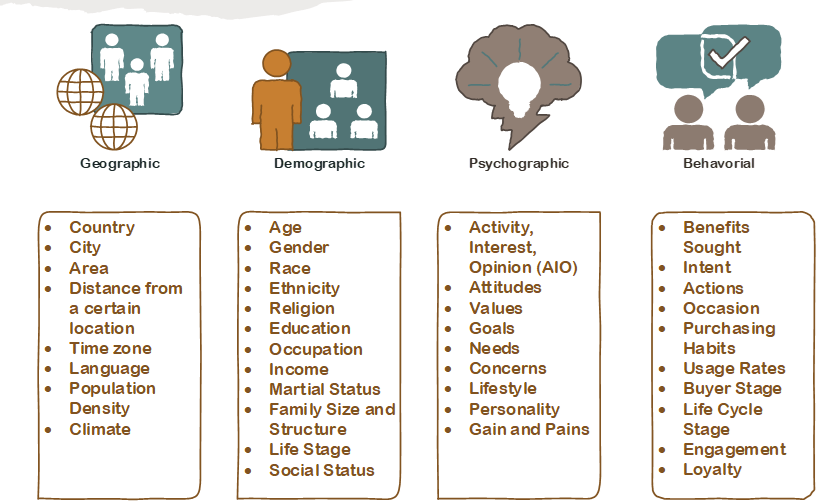
Now you have a profile. Test it. Look at each attribute and say “is this really compelling?” and “does this change customer motivation?”. Must like all marketing profiles become, well, me. It’s easy to just reduce yourself to the most common demographic properties of your population. The name Jennifer was really popular in the 80s, women 35-45 have a lot of buying power, and that demographic is really likely to be married with 2 kids. None of those characteristics are likely to be compelling to any particular problem statement. I don’t need software to organize my kid’s schedules because I am in my 40s and married. Having kids is compelling. But likely being a busy professional and upper income are more impactful on that need.
Application
Once I have a ICP that I have walked around the organization it become a foundation for conversations we have with stakeholders and inside the team. Does this feature help our ICP? What are we saying no to? Do our recent customers look like our ICP? If there is slide, what is it and does it mean we need to adjust the ICP or we are starting to muddy our value proposition? How recently have we talked to a customer who looks like our ICP? What needs did they have that we aren’t currently solving?
Note: I don’t use AI to help write my posts or create example pictures. The segmentation cheat sheet is my creation and is also present in my Build Things People Want talk. I did use AI to create the header image, in this case ChatGPT with the prompt “create an image of glenngarry glen ross in the style of insane clown posse”.
 Jennie Ocken