Recently, I was chatting with a friend of mine who is head of operations at an agency. We were discussing our different leadership strategies and how we deal with different kinds of complexity in our very different environments and job types. I told her I had to turn that conversation into a blog post, and she gave me permission to do so.
Cynefin Explained
One of our favorite mental models is Cynefin. This framework was developed by Dave Snowden in 1999 and helps leaders understand different kinds of problems and how to apply the correct kind of thinking to each kind. This image of the model is my adoption of it that I use when I speak at conferences or to teams.
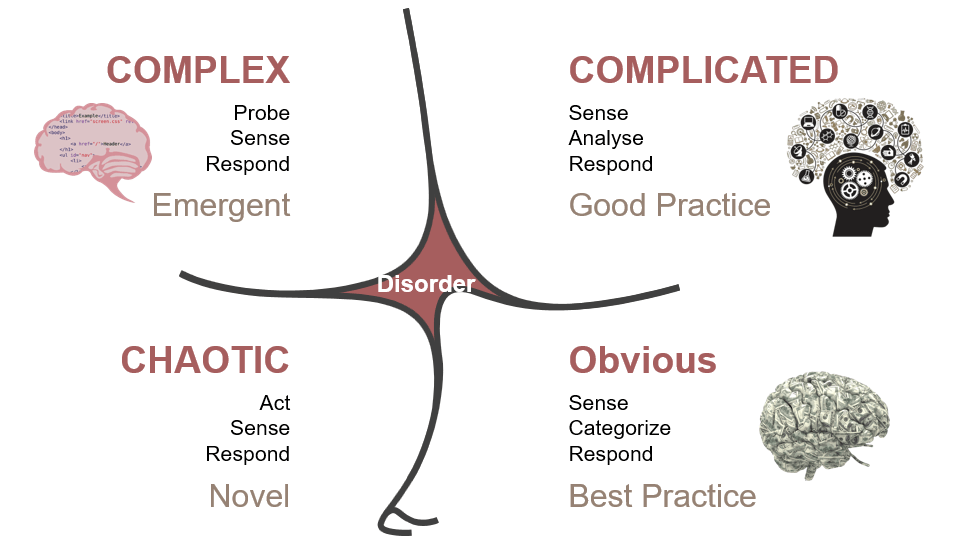
The first quadrant is “Obvious”, sometimes also referred to as Simple or Clear. These are problems where the solution is pretty straightforward. There is a direct relationship between cause and effect and you can write a policy that covers what should be done. To solve problems in this category you first sense the problem, then categorize it based on what other problems it looks like, and respond, most often with “best practices”. If I have an obvious problem come anywhere near me during the workday, I start looking for process breakdowns within my environment.
The second quadrant is “Complicated”. This is where expert analysis is needed because multiple good and right answers are available. Instead of a documented “best practice” you are trying to figure out the best solution from a selection of “good practices” with tradeoffs. There is often a good understanding of “known unknowns” that impact the decision. Often it is the case where we know what research needs to be done, what questions need to be answered, but not to go about answering them. Cause and effect are discoverable but not known. Here you are sensing the problem, analyzing it, and then responding. The best path here is to figure out how to break a complicated problem into several obvious ones without losing the linkages.
The third quadrant is “Complex”. This is where the problem can even be obscure or not commonly agreed to. There is no relationship between cause and effect with patterns emerging over time. The problems are more unpredictable than predictable. This is the area of unknown unknowns, emergent ideas, and experimentation. Here you probe the problem(s), sense what they are, and then respond. The best path here is to evaluate a step, take it, and then see what happens before deciding on the next step.
The fourth quadrant is “Chaotic”. This is the immediate crisis with no manageable cause and effect. The site is down, the building is on fire, the ship is sinking. The immediate priority is containment and response time is more important than the “right” solution. Here you act first, then sense what’s going on once the immediate crisis is contained, then respond. When I have worked closely with network teams, we spend a lot of time in chaotic, preventing chaotic, or cleaning up previous chaotic problems.
In the middle of the diagram is “Disorder”. This is when you don’t know which category you are in. Most often you end up in disorder because you evaluated a problem at the wrong quadrant and “fell off the edge” between Obvious and Chaotic. Problems move clockwise around the framework. You don’t have the ability to sense the problem and until you can, you can’t respond.
In general, the Cynefin model helps you have conversations about what kind of problem you are dealing with and who you need to be involved in solving it. It helps avoid over-simplification in problems and one-size-fit-all problem solving.
It’s my personal theory that different people, with different brains, have a preferred category they default to (this is the different brain images on my model). Most account managers and client strategists live in complicated. Nothing is straightforward but nothing is hard, it just takes some thinking time. Most salespeople, and clients, live in obvious. Nothing could actually be hard enough to be that expensive. Most engineers I have worked with live in complex. Everything is an experiment. The conversational breakdowns I have witnessed between these groups are often because of these different baseline assumptions.
Cynefin Applied to Complex Leadership
So back to the conversation I was having with my operations friend. We both tend to default to the complex way of thinking and deal really well with that level of ambiguity. But we have totally different approaches within complex problems. She only feels happy starting to solve a problem if she knows she will be able to finish it. I don’t have this constant. I think this is because of how concretely we each see the solution space. She envisions the outcome she is going for and drives towards that outcome, through multiple experiments and difficult conversations. She has the vision of where we going and is leading people towards that outcome. Which is often what people are asking for when they say they don’t understand leadership’s strategy. It’s that they want to have clear milestones along the way and a consistent north star vision. I have to work to provide that for my works because the way my brain works, I am totally okay if we never get “there”. I’m not even sure a “there” exists. I see the world and how I want it to be different and am totally happy to keep making small adjustments that move us more towards that ideal without ever totally understanding where that ideal is.
Neither approach is better or worse. Approaching complex problems with a “we are going there” doesn’t mean you are uncomfortable in complexity. Just the same as approaching complexity with “we will know it when we see it”. Both are totally rational ways of dealing with the anxiety created by not having an answer. This is the reason I think a lot of leaders don’t work well in complexity. I don’t have answers to most questions. I have questions before answers. And more questions than answers. And more comfort with “yeah, that feels right”. Our modern product practices love metrics and moving metrics. But there also needs to be room for intuition and the long game. That’s where truly monumental, world changing problems are solved.
Note: I don’t use AI to help write my posts or create example pictures. I also didn’t use AI to do the header image. I tried but all of them came back with a Cynefin diagram, some of them done very wrong. ChatGPT had the quadrants in the wrong order. One had “complex” with a picture of a building burning in the background and “chaotic” with a developers at the computer. Claude built the model right but it wasn’t better than my framework image I use in presentations and couldn’t keep text in the boxes. Gemini did it infographic style but the quadrants are going counterclockwise. CoPilot at least got the quadrants in the right order and going clockwise but the image was a little frightening reminding me of becket’s Happy Days. So I closed them all and just used my own previously generated image.
 Jennie Ocken