You’ve seen Frozen 2, right? I mean, if your household is anything like mine, it’s playing on repeat in the background as children scramble, color, and fight. Admittedly, I have only sat and watched it end to end once. Still, there is one part of the movie that stick out to me and, I think, has a lot to teach us about business decision making and product management. Warning, movie spoilers ahead.
After discovering a lot of hard truths about her own grandfather’s culpability in a generations long unnecessary war, and the apparent loss of her sister to the ongoing tragedy (who said children’s movies were lighthearted), Anna is stuck. She must standup, dust herself off, and determine what to do now. She sings a hauntingly beautiful song about grief and figuring out how to go on.
I don’t know anymore what is true
The Next Right Thing, Frozen 2
I can’t find my direction, I’m all alone
The only star that guided me was you
How to rise from the floor?
But it’s not you I’m rising for
Just do the next right thing
Take a step, step again,
It’s all that I can to do
The next right thing
I won’t look too far ahead
It’s too much for me to take
But break it down to this next breath, this next step
This next choice is one that I can make
Often I find myself at an impasse. Maybe it’s not the fate of the world and the righting of generations of wrong sitting on my shoulders, but the pressure does affect me none the less. Sometimes it is something stupid simple like how a UI interaction should work. More often it is the juggling of priorities. My team can only tackle one thing right now, here is the list of problems facing us, what is the next right thing. And there it is, the song pops into my brain and wiggles itself down into my toes.
These are the moments I take a step back, like Anna, and see what inspiration sticks me.
- Can I easily summarize the problem?
- What is the root cause of the problem?
- Who else can I talk to about this problem? Do we agree on the same problem, or do they have a different perspective on it?
- Why do I feel like this is a real problem? What are the consequences of not addressing this problem? Who will be affected and how soon if the problem persists?
If you have ever read anything I have written or listened to one of my talks, this will sound like pretty Jennie-standard-faire. Find the problem statement and the solution will become apparent.
The struggle I have when I train and talk to other product managers how much we want, and sometimes need, a structure for this kind of decision. Instincts and experience are not scalable. So, we must find some balance between structure that helps in decision making with the instincts that allow good decisions to be made quickly and with a decent right/wrong percentage. Over time these tools can become second nature. Here are a couple of my favorites:
Prioritization Matrix:
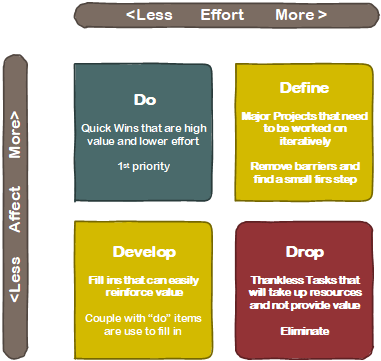
Draw a 2 x 2, label one axis with affect measures such as:
- Urgency: How quickly someone will feel the affect
- Density: How many people will feel the affect
- Impact: Significance of the change to the people affected
- Importance: The importance of the people feeling the affect to your organization
Label the other axis with an effort measure such as:
- Level of effort: How much effort it will take your team to address it
- Feasibility: Likelihood the problem is solvable
- Isolation: Ability to solve the problem without having to solve all other problem (or a measurement of dependencies
Once you have your problems laid out in your matrix you can easily determine which to action on by using this rule of thumb:
Tell a Story
Find a friend and tell them the story of your problems. Have them keep track of how many times you bring up the same problem in your narrative of what is happening to your users. Generally, that is the problem your instincts are telling you that needs to be solved first.
Anna leaned towards the “tell a story” method. She looked around at her situation and said, “here is what I see going on, here are all the pieces of what I observe.” And from there she was able to figure out the next right thing without getting too focused on what comes after that step. Sometimes it is that trust in ourselves that we need to be growing.
 Jennie Ocken