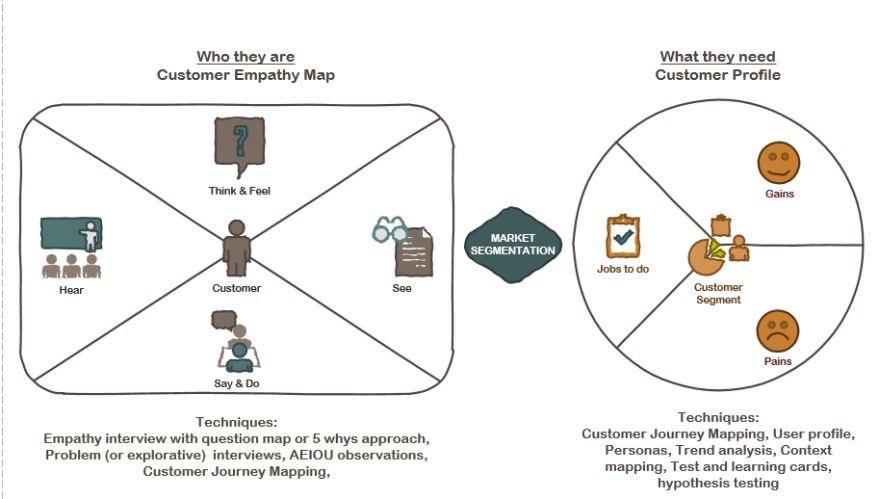
The biggest mistake young companies make is trying to sell everything to everyone. It is impossible to get a clear value proposition or distinct competitive advantage without a targeted market segment. The biggest mistake older companies make is not realizing when the market has changed and that segment is consolidating, shrinking, or shifting. Both of these, sometimes fatal, mistakes stem from the same place: not understanding your “who”.
Developers have challenged me over the course of my career as a product owner to help them build things people want. It’s a deceptively easy demand to make because it is much too easy to assume that if it sells it is valuable. However, I am not just concerned about today’s profitability. I am concerned about tomorrow’s customer, scalability, and competitive landscape. I am not just concerned with today’s customers. I am concerned with customer retention (stickiness), customer acquisition, and the balance of power within my market. So how do you understand your “who”?
Start with “who” you know
The best way to understand your unique market segment and positioning is your current customer. Prospects who look like you already sell to are your strongest potential customers. However, too often when we do this kind of comparison it’s based on demographics. While demographics can be powerful, they don’t tell the entire story. Marketing personas are primarily demographics based in my experience. At three different companies I have worked at, with dramatically different products, value propositions, and markets, they all had the same basic marketing persona: Jennifer. She’s between 25 and 45. She works in marketing. She drinks coffee in the morning. She has two children and a dog. She is very busy and doesn’t have time for your messaging. She is looking for something to simplifier her life. I feel bad for her, in addition to her full time job, she has to pose for all these marketing documents.
Jennifer is fine. I have nothing honestly against her. Demographics are valuable for our marketing and sales teams because that is how marketing spend is targeted. However, at the end of the day, I am not building marketing messages I am building products. I want to know what gets under her skin. I want to know what frustrates her enough that she will give me her money to save her time. When I am looking at market segments, I am not looking at how to find that customer. I am looking for the unique set of challenges she is trying to solve. I am looking for problem statements.
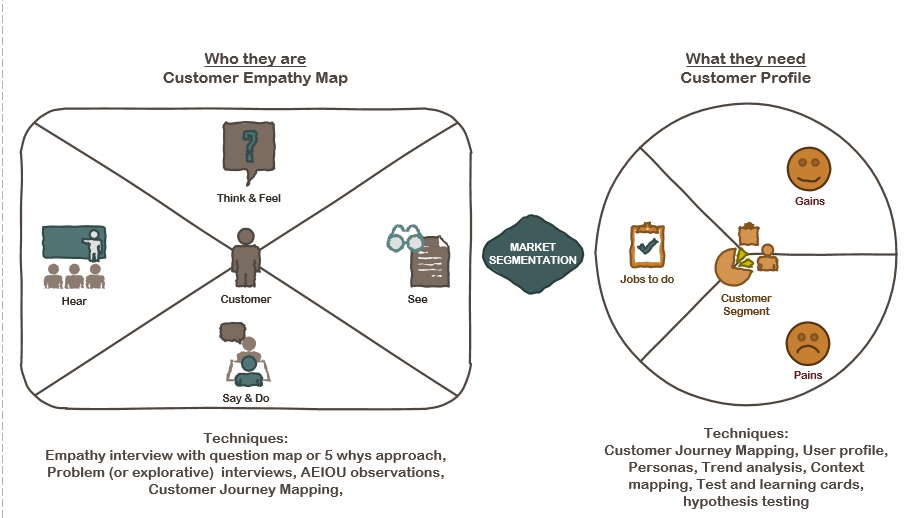
So, start by talking to your current clients to build a customer empathy map. You want to know where your product fits into their lives. What problems does it solve? What problems does it create? What other solutions are they using to solve similar (in their mind) problems? What does their daily life look like? Who in their industry do they admire? What are those people doing differently?

My favorite technique for building a customer empathy map is a problem interview. A problem interview is an open inquiry into what a user’s experience is. When using this technique for building out your market landscape, stay high level instead of diving into specific problems and products. Essentially, a problem interview is there to give you a framework for a frank conversation. The format I like to use looks like this:
Introduce yourself and why you are asking questions
- Introduce yourself
- Set the stage for the questions you will be asking
- Make the conversation feel safe
Hi, I’m Jennie. I am the product owner of this awesome product you currently use. This means I get to understand what we are doing to help you and how to make things for you even easier. I am talking to a bunch of our customers right now to better sense of how we fit into their lives. I appreciate you taking the time to talk with me today. I may ask some questions that may seem a little off beat and I may ask you to repeat yourself. This is just because I want to understand fully what you are saying. This is not a sales call and at no point am I going to ask you purchasing questions. There are no silly answers.
About them
- Demographics and relationship to the product
- Goals for using the product
I would like to just start with a sense of your position within your company and how you use our product. What is your title? How frequently do you use our product? How do you measure success? Who makes the purchasing decision?
Tell me about the last time you …
- Ask open ended questions about the usage of your product
- Follow up with “why was that painful?”
- Stay focused on what they are saying and ask follow up questions specific to their experience
Can you tell me about the last time you used this widget, what were you trying to accomplish? What went wrong? What went right? Why was that painful? What could have gone better? Tell me more about your experience. Who else used this widget? How else have you solved this problem? What other problems is this solution causing you?
Go through this process with many clients until you start to see patterns.
Build Segments
Based on your customer interviews and customer empathy map, you can start to get a sense of some product-based segments. These should be based on the problems the users are trying to solve. Get creative in how you break this down. You will start to build out a set of customer profiles. A good customer profile includes the jobs the user is trying to accomplish and what they gains and pains they have from their current experience.
Based on understanding the segments you have built from current customers, you can look at the market at large to see where your product fits in. You will quickly see adjacent markets based on product appeal at which point you can start to measure and test what it would take to attract those customers. You can also start to see trends in your market penetration and market drift. Are you still selling to the same people you have historically? Is the size of that market segment changing? Is your appeal to that market segment changing? Are the problems that market segment is facing changing? What nearby segments could you start to appeal to by shifting simple things about your product, marketing messaging, or service model?
In other words what you are doing is:
- Interview your existing customer base
- Build customer empathy maps for each customer
- Group customers together based on common problem statements
- Build customer profiles based on those group
- Group your entire customer base into those segments
- Evaluate the market at large based on the segment penetration of the current customer base
RFPs, proposals, market forums, product reviews for competitive products are good sources for understanding the problem statements for non-customers in similar or adjacent markets. Putting it together, it ends up looking like this:
I have found this approach to be very effective for building out a backlog and product vision within a company with an existing customer base. Keeping in touch with your customer base as the market changes is essential to keeping a viable product vision and understand where your product is within the product lifecycle. Not all product opportunities are for an existing market or with an existing company. In a future post I will talk about how to tackle that challenge.
Build things people want
When building a product, no matter what it is, it is essential to start with the “who”. Over time, markets change. Problems change. The availability of solutions change. Budgets, purchasing patterns, structures at client organizations change. Your product is a living solution to problems. It needs care and feeding. So does your understanding of the problems the people you are building the product for.
In future posts I will talk more about the “want” part of Build Things People want. I want to talk about:
- Hypothesis Testing
- Product roadmap planning
- Deciding what not to build
- Building the product box
 Jennie Ocken